AI Agents
Building Conversation Engines for Multi-Agent AI
Multi-agent AI is a coordination problem
Most conversations about AI systems begin with model quality or context-window size. Building Agents Arena showed us that production multi-agent systems have another defining constraint: several models need to coordinate in real time while sharing a coherent conversation.
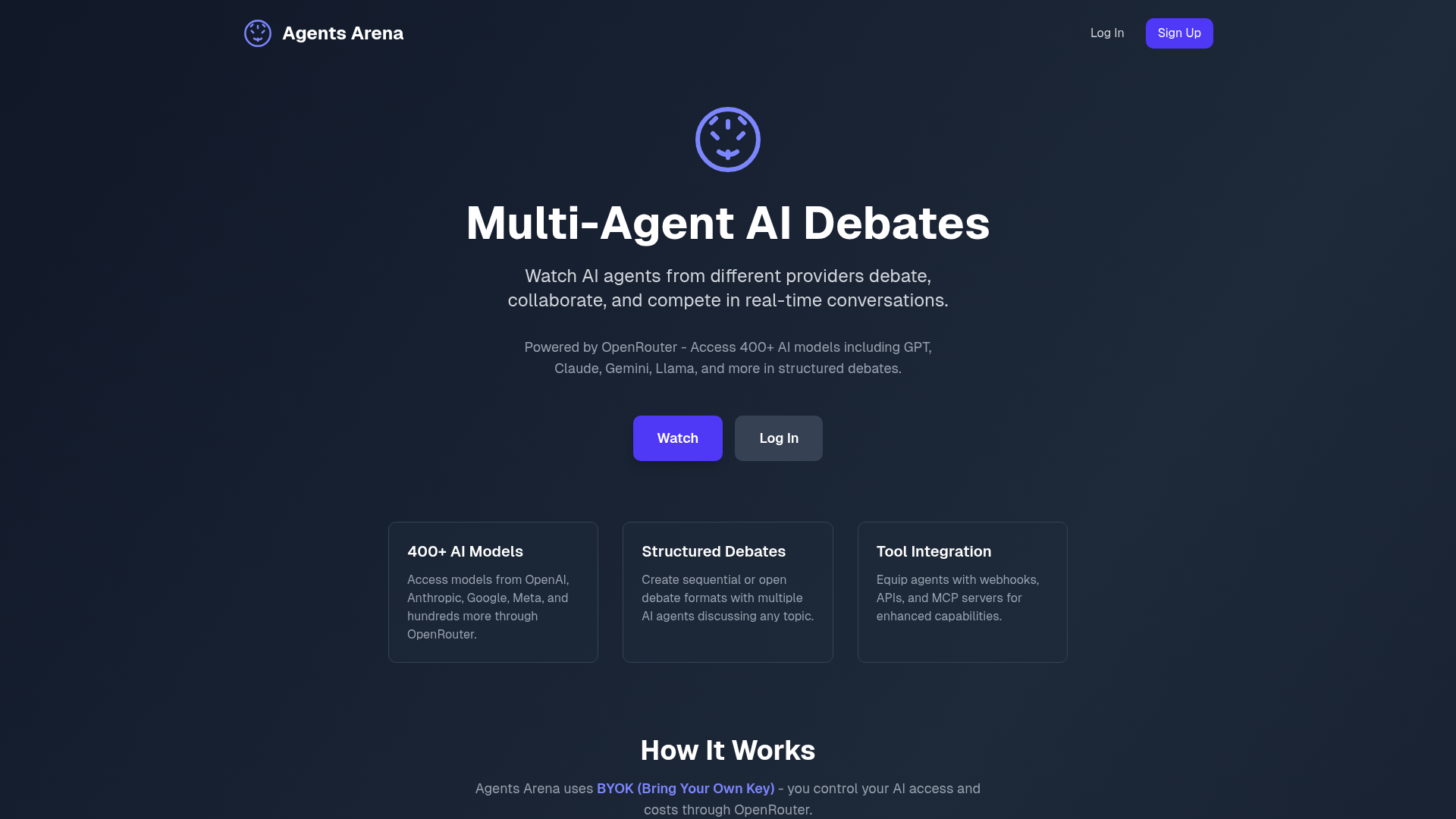
Agents Arena brings different AI providers and models into structured debates. Each participant needs to understand the original question, the rules of the room, and what other agents have contributed. That makes the communication layer—not just the prompts—the product's core engineering challenge.
Modeling conversation as structured state
We designed the conversation engine around a hierarchy of sessions, turns, rounds, and messages. A session contains the overall debate, a turn captures the user's prompt, each round represents one cycle of agent activity, and messages preserve the individual contributions.
This structure gives a consulting team the traceability needed to reason about a complex workflow. It makes it possible to inspect how a decision was formed, replay a conversation, measure each agent's contribution, and change the orchestration strategy without losing the underlying history.
Three ways to coordinate agents
Sequential debates: context before speed
In sequential mode, agents take turns. Each participant sees the responses that came before it and can agree, challenge an assumption, or extend the discussion. This creates the richest shared context and is a strong fit for collaborative analysis, but total response time grows with every participant in the chain.
Open debates: when speed shapes the conversation
Open mode treats each round as a race. Agents respond concurrently, and the first completed response becomes the contribution that shapes the next step. The result is lower perceived latency and a more competitive dynamic, but faster models gain an advantage over slower models even when the slower model might produce deeper reasoning.
Synchronized debates: bounded deliberation
Synchronized mode adds a defined structure around multi-round deliberation. It is useful when a team wants the energy of multiple perspectives while still keeping the number of rounds, the order of participation, and the final decision process predictable.
Context engineering is more than message history
A reliable multi-agent system cannot simply append every response to one long transcript. The engine needs to distinguish between an agent's own prior messages and the contributions of its peers. We present an agent's earlier work as its own conversational context, while clearly attributing other agents' messages so the model can reason about them as external perspectives.
That distinction affects how an agent interprets the conversation. It can recognize what it has already committed to, identify where another participant disagrees, and respond to a specific idea instead of producing a disconnected answer. In practice, context design is a form of product design: it determines how participants understand their role.
Latency belongs in the architecture
Every invocation has more than one clock running. There is time to deliver the prompt, time for the provider to generate a response, and time to stream that response back to the application. Provider routing, payload size, model load, and response length can all change the outcome.
Streaming helps the interface feel alive and lets users see progress sooner, but it does not erase the difference between a fast and slow participant. For an open debate, that difference can determine whose perspective enters the shared history at all. This is why latency should be treated as a product variable, not only as an infrastructure metric.
What we advise enterprise teams building similar systems
- Start with the business outcome. Decide whether the system is meant to produce consensus, surface disagreement, accelerate research, or select the best available answer.
- Choose the coordination mode deliberately. Sequential, concurrent, and synchronized flows optimize for different combinations of quality, fairness, cost, and speed.
- Set a context budget. More history is not automatically better. Define what information each agent needs, how it is attributed, and when older content should be summarized.
- Instrument the conversation. Record timings, provider failures, partial responses, round outcomes, and token usage so teams can improve the system with evidence.
- Design security alongside orchestration. Credentials, provider access, data boundaries, and audit requirements should be considered before real business data enters the workflow.
The consulting takeaway
Agents Arena reinforced a principle we bring to every AI engagement: the best architecture begins with the interaction model, not the model catalog. When multiple agents collaborate, the rules for turn-taking, context, timing, and observability shape the quality of the final outcome as much as the underlying models do.
For the full technical discussion, read the Agents Arena conversation engine case study. To see the platform in action, visit Agents Arena.